

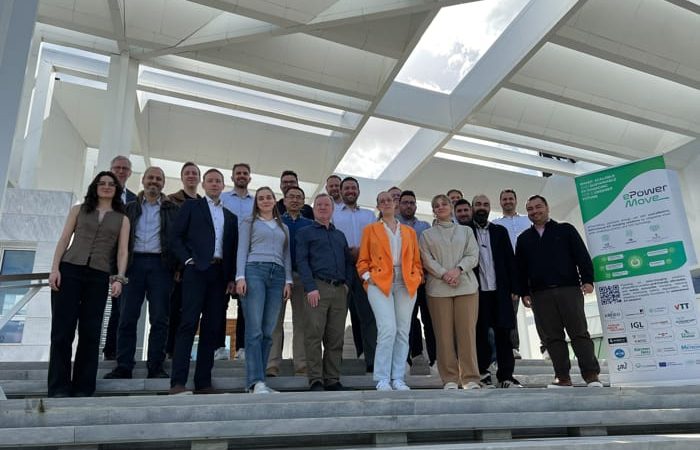
The ePowerMove project, funded by the European Union’s Horizon Europe research and innovation programme, successfully held its General Assembly on 17–18 February 2026 at the University of Cyprus, in Nicosia.
Bringing together partners from across Europe, the two-day event provided a platform for in-depth discussions on technical progress, coordination, and upcoming project activities in support of intelligent, inclusive and scalable electric vehicle (EV) charging solutions. The meeting included experts from research institutions, industry, and mobility stakeholders working collaboratively to accelerate the transition to sustainable electromobility.
During the meeting, partners reviewed advances across key work packages, covering socio-cultural co-design and end-user requirements, development of low-cost and bidirectional charging technologies, smart system and grid integration, large-scale demonstration planning, and communication and dissemination strategies. The discussions also focused on optimisation, technical management, and planning for future milestones.
The project has already achieved the following technical milestones:
1. Quantitative survey in pilot cities to identify different citizen segments. A large-scale survey conducted in the pilot cities of Helsinki (Finland), Klagenfurt (Austria), and Nicosia (Cyprus) collected insights from citizens to identify user segments, mobility behaviours, and attitudes toward EV charging and V2G energy services.
- Technical requirements, constraints and needs collected and concluded. Technical, regulatory, grid, and installation requirements were analysed across the three pilot environments in Helsinki, Klagenfurt, and Nicosia to define the operational conditions for deploying cost-effective bidirectional EV charging infrastructure.
- Bidirectional AC charger requirement specification completed. A comprehensive specification was developed outlining the technical, interoperability, and grid-integration requirements for the bidirectional AC chargers to be deployed across the pilot sites.
- Well defined data-exchange and functional requirements for each grid/charging-level solution. Detailed data exchange protocols and functional requirements have been defined to ensure effective communication between EV chargers, grid operators, and energy management systems in the Helsinki, Klagenfurt, and Nicosia pilot demonstrations.
A highlight of the event was the visit to the KIOS Research and Innovation Center of Excellence Power Lab, where participants were introduced to UCY’s research infrastructure supporting EV charging and energy system integration.
The meeting reaffirmed the consortium’s commitment to developing people-centric, grid-friendly charging infrastructure that supports Europe’s energy transition while addressing user needs and practical deployment challenges.
 This project has received funding from the European Union’s Horizon Europe research and innovation programme under grant agreement 101192753.
Views and opinions expressed are however those of the author(s) only and do not necessarily reflect those of the European Union. Neither the European Union nor the granting authority can be held responsible for them.