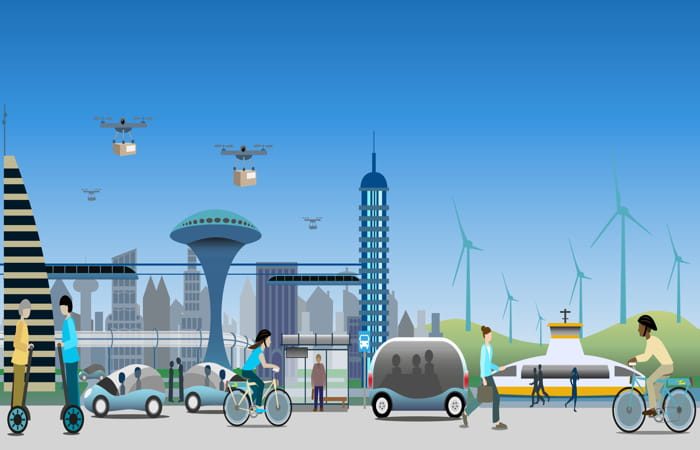
FEDORA project aims to make European transport more efficient, sustainable, and user-centred, connecting multiple transport modes (road, rail, air, and waterways) through intelligent data sharing and advanced digital tools.
European mobility systems face increasing challenges:
- Transport networks are fragmented, with limited coordination across road, air, rail, logistics, and micro-mobility services.
- Data from different operators and authorities is not easily accessible or interoperable.
- Cities struggle to predict and manage congestion, integrate emerging services (like drones), and respond to disruptions.
- Simulation tools and real-world systems are not aligned, making it hard to test innovations safely before deployment.
- The growing demand for sustainable mobility requires smarter, greener, and more inclusive traffic management solutions.
FEDORA addresses these challenges by developing a digital ecosystem to connect:
1) A multimodal data space, for secure, cross-sectoral data sharing;
2) A Next-Generation Traffic Management Service Space, offering AI-enabled optimization, dynamic pricing, nudging, and incident response tools; and
3) A Multimodal Simulation & Foresight Space to test scenarios, predict mobility demand, and evaluate future solutions.
FEDORA’s approach will be validated in six pilot sites across Europe (Austria, Spain, Cyprus, Denmark, Italy, Hungary), each representing unique mobility contexts, infrastructure maturity, and operational challenges.
The project brings together 16 partners from 11 countries, including leading universities, research centers, mobility operators, technology providers, and international associations. It is coordinated by ERTICO ITS.
Project’s website: https://fedora-horizon.eu/

Funded by the European Union. Views and opinions expressed are however those of the author(s) only and do not necessarily reflect those of the European Union. Neither the European Union nor the granting authority can be held responsible for them.