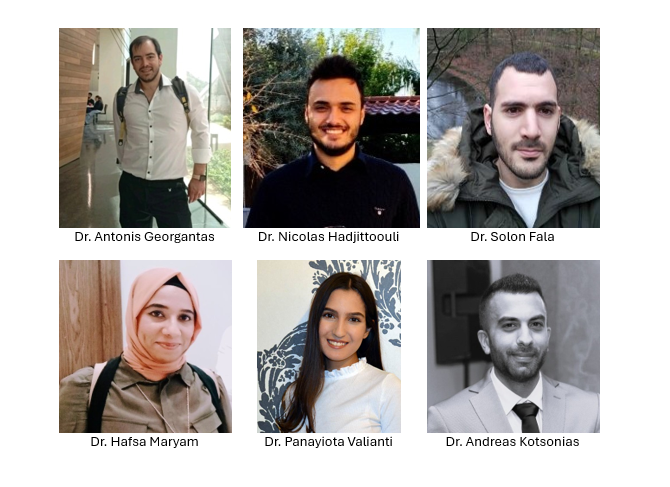
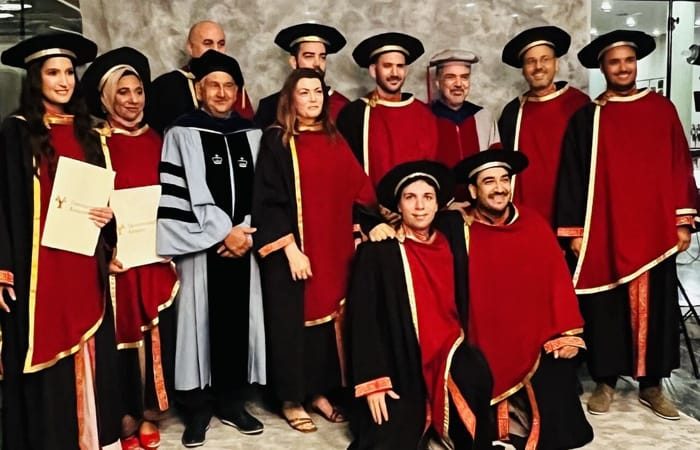
Six new PhD students from the Department of Electrical and Computer Engineering (ECE) at the University of Cyprus, who conducted their research at the state-of-the-art facilities of the KIOS Research and Innovation Center of Excellence, graduated on 25 June 2026, following the successful completion of doctoral research across transport optimization, medical imaging, cybersecurity, optical networks, unmanned aerial systems, and smart grid management.
Dr. Antonis Georgantas, (supervised by Profs. Christos Panayiotou and Stelios Timotheou), developed an optimization framework to mitigate morning traffic congestion by adjusting school start times. Using a calibrated traffic model of Nicosia based on real loop detector measurements, his research showed that coordinated changes to school schedules can reduce citywide road congestion by up to 7%, while keeping disruptions within practical and socially acceptable limits. The framework offers transport authorities a data-driven tool for evaluating traffic interventions before real-world implementation.
Dr. Nicolas Hadjittoouli, (supervised by Prof. Costas Pitris), developed mathematical tools that unfold the curved surface of the skull into a flat map, making fractures easier to detect across CT scan slices. The same approach was applied to the heart, flattening complex 3D electrical activity during dangerous heart rhythm disorders into a standardized 2D view. The research aims to make medical imaging faster to interpret and cardiac studies easier to compare across patients.
Dr. Solon Falas, (supervised by Prof. Maria Michael and Dr. Markos Asprou, Research Lecturer), developed new hardware- and physics-based security methods to protect modern cyber-physical systems from cyberattacks. His research introduced secure firmware update protocols for resource-constrained embedded devices, alongside physics-informed neural networks (PINNs) that embed the physical laws governing power grids directly into machine learning models, enabling robust, attack-resilient state estimation even under sensor noise, missing data, or adversarial manipulation. The work equips critical infrastructure operators with practical tools to detect and withstand cyber threats targeting embedded and power systems.
Dr. Hafsa Maryam, (supervised by Prof. Georgios Ellinas and Dr. Tania Panayiotou, Senior Research Associate), investigated traffic prediction and quality-of-transmission (QoS) estimation in optical networks using machine learning. The aim of the thesis was to incorporate both model and input uncertainty directly into connection provisioning decisions, enabling more reliable and resource-efficient QoS-aware network optimization.
Dr. Panayiota Valianti, (supervised by Profs. George Ellinas and Panayiotis Kolios), proposed a multi-agent framework in which a team of pursuer unmanned aerial vehicles (UAVs) cooperates to monitor and jam one or more malicious UAVs, with the goal of disrupting their operation. A joint mobility and power control strategy is developed to optimize the decisions of each agent (centralized and distributed formulations), ensuring effective tracking and interception. The thesis also proposes an integrated approach combining search, tracking, and jamming within a unified multi-agent reinforcement learning framework.
Dr. Andreas Kotsonias, (supervised by Prof. Christos Panayiotou, Dr. Markos Asprou and Dr. Lenos Hadjidemetriou, Research Lecturers), developed an advanced management system for Low Voltage Distribution Grids to mitigate the adverse effects of high solar and electric vehicle penetration. The system enhances situational awareness of distribution grids and addresses critical constraints such as voltage and distribution lines thermal limits, voltage unbalance, and harmonic distortion, while ensuring fair use of end-users’ assets.
According to the KIOS Director, Prof. Christos Panayiotou, “These six theses reflect the caliber of research being carried out at KIOS, spanning transport, health, cybersecurity, telecommunications, unmanned aerial systems, and energy. Each of these students has tackled a real-world challenge with scientific rigor and originality, from easing traffic congestion in our cities to securing critical infrastructure and improving how we diagnose disease. We congratulate our graduates and wish them every success in the next stage of their careers“.