

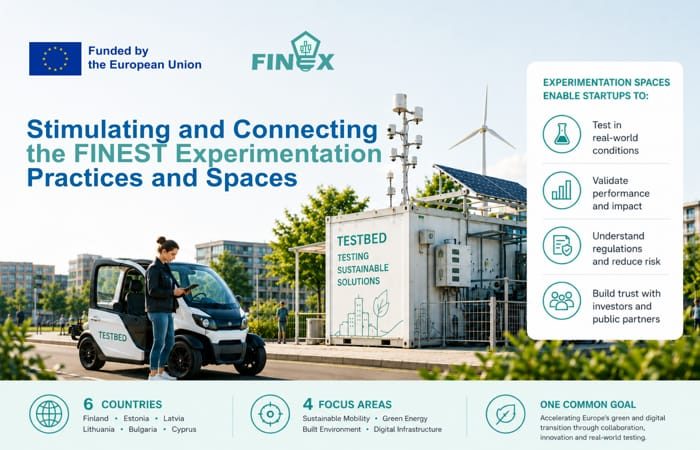
Europe’s cleantech startups are developing technologies that reduce emissions, modernise cities and strengthen energy resilience, but many still struggle to move from innovation to real-world deployment. The FINEX project concludes that experimentation spaces play a critical role in accelerating Europe’s green and digital transition by helping cleantech startups test innovative solutions in real-world conditions. At the same time, the project reveals major barriers, including regulatory delays, funding shortage and administrative complexity, that continue to slow innovation deployment across Europe.
Implemented across Estonia, Finland, Latvia, Lithuania, Bulgaria and Cyprus, FINEX focuses on connecting startups with experimentation spaces that allow them to test and validate sustainable technologies in real-world environments. Experimentation spaces include living labs, testbeds, regulatory sandboxes and testing facilities where innovators can safely test new technologies, services or business models before entering the market. These environments help startups collect operational data, validate solutions and business models, understand regulations and reduce risks connected to large-scale deployment.
The project aims to identify what kind of support innovators need most, how experimentation environments can accelerate development and deployment, and what obstacles prevent promising technologies from reaching the market.
Matching innovators with Europe’s experimentation spaces
One of the main goals of FINEX is to improve matchmaking between innovators and suitable experimentation environments. The project developed a methodology that guided startups from initial assessment to pilot implementation. Innovators were assessed based on their technological readiness and sector-specific needs before being matched with suitable experimentation facilities across Europe.
FINEX project selected one pilot project from each partner country and matched innovators with experimentation spaces suited to their technological and operational needs. Selected pilots focused on five strategic cleantech areas: mobility, energy, built environment, data analytics and governance. Through workshops and ecosystem discussions, FINEX partners identified regional innovation gaps and explored how experimentation infrastructures could address local sustainability challenges.
This process helps startups gain international visibility and establish cross-border partnerships. Several startups said the networking opportunities and international connections became just as valuable as the technical testing itself.
Real-world testing strengthens innovation credibility
The pilot activities show that startups benefit significantly when technologies can be tested in realistic operational settings before market launch. Experimentation spaces help innovators improve technical validation, gain credibility with municipalities and investors and better understand regulatory and operational requirements. The pilot projects covered a wide range of cleantech challenges, demonstrating how experimentation spaces can support solutions at different stages of development and across multiple sectors.
In Latvia, the pilot tested electric cargo scooters designed for urban logistics and city maintenance. The project explored how lightweight electric vehicles could replace traditional delivery vans in congested urban environments and contribute to emission reductions.
In Cyprus, the pilot used digital twin technology to coordinate domestic electric water heaters and improve grid stability during periods of high energy demand. Meanwhile, Lithuania’s pilot developed water-based lithium-ion battery recycling solutions aimed at reducing dependence on imported raw materials and improving circularity in the energy sector.
The built environment pilots also highlighted practical applications for experimentation spaces. Estonia’s pilot tested a digital pre-demolition audit system that identifies reusable construction materials before demolition takes place, while Bulgaria’s pilot used edge artificial intelligence to monitor urban greenery and predict environmental changes locally.
Regulatory fragmentation and funding gaps remain major barriers
While the pilot projects demonstrate well the value of experimentation spaces, they also reveal several structural barriers that continue to limit the speed and scale of cleantech innovation across Europe. Regulatory fragmentation between EU member states was repeatedly highlighted as a major obstacle. Additionally, startups faced differing permit procedures, shipment regulations and testing requirements depending on the country.
Some innovators reported that permit approvals took up to six or seven months, creating delays that many early-stage companies could not financially sustain. Limited funding was another significant concern, particularly for pilots involving advanced infrastructures such as digital twins, sensor systems and cross-border testing facilities.
Administrative complexity also slowed implementation. Startups encountered difficulties related to agreement signing, registration procedures and coordination between multiple regions and organisations. According to the project findings, these bureaucratic burdens can become especially challenging for smaller innovators with limited resources.
Collaboration seen as key to future growth
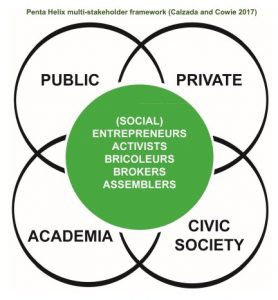 One of the strongest conclusions from the FINEX pilots experience was that successful innovation depends heavily on cooperation between different stakeholders. The project applied the “Penta-Helix” approach, bringing together public authorities, private companies, academia, civil society and intermediary organisations.
The pilots showed that strong partnerships and active communication are essential for successful experimentation. In one Finnish pilot involving satellite-based monitoring technologies, delays occurred because project partners became unresponsive, highlighting how fragile innovation projects can become without stable collaboration structures.
At the same time, several startups reported that the international networking opportunities created by FINEX opened doors to future cooperation projects, cross-border partnerships and potential funding opportunities. FINEX therefore demonstrated that experimentation spaces can strengthen not only technology development, but also long-term ecosystem growth.
FINEX highlights the future role of experimentation spaces
The project concludes that experimentation spaces should be treated as long-term strategic instruments that help bridge the gap between innovation and real-world deployment. FINEX recommends simplified regulations around cross-border collaboration and improved financial support mechanisms to help startups access experimentation environments more efficiently.
The project demonstrates that experimentation spaces are not only testing facilities, but also important mechanisms for building partnerships, reducing deployment risks and strengthening Europe’s innovation capacity. However, it is also important for the pilots to understand the wider ecosystems around them as many of the deep tech solutions are complementary technologies and need other technologies around them to build a market-ready product or service. Thus, for the successful deployment of these technologies, a change is needed not only in the technological setting but also in organisational and institutional frameworks, including regulations, technology and product value chain, etc.
Learn more about FINEX from the HelpDesk: https://28digital.eu/finex-helpdesk